Historical Research
The Hinchman Name
An extended historical and genealogical study of the Hinchman, Henchman, and related English family lines — from Old English origins to the American frontier.
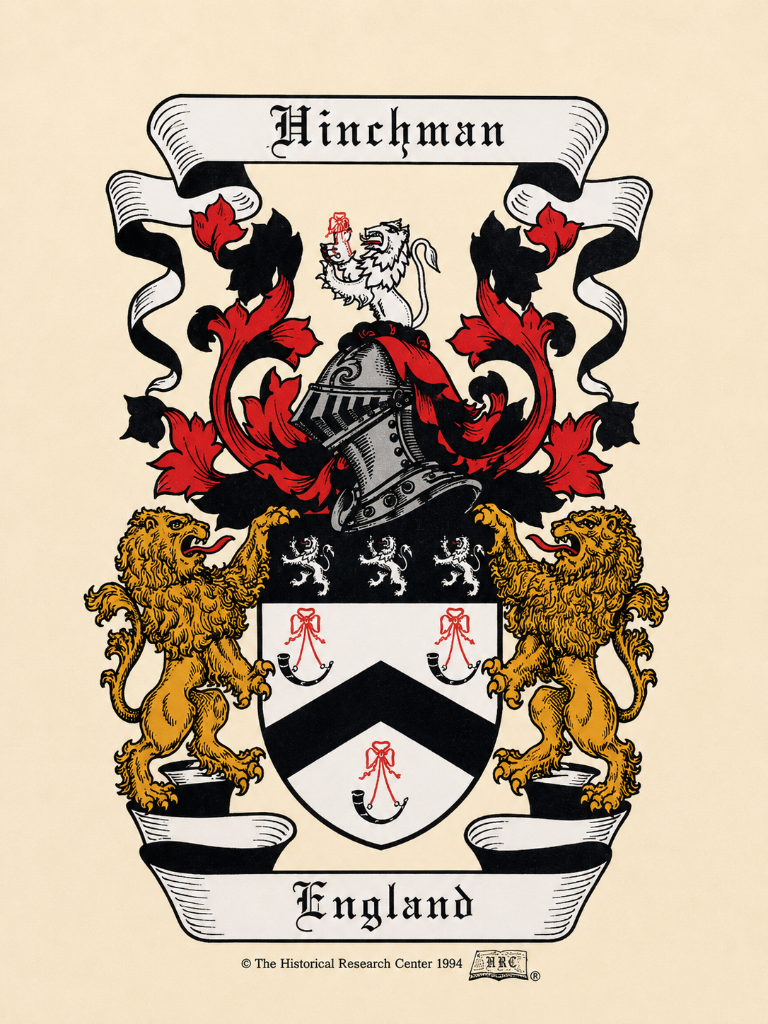
Hinchman Family Coat of Arms · England
© The Historical Research Center 1994
Heraldry
The Hinchman Coat of Arms
The Hinchman family coat of arms features classic English heraldic elements that reflect the name's medieval origins. Two golden lions stand as supporters on either side of the shield — a symbol of courage and nobility. The shield itself bears a bold black chevron, with three buglehorns decorated with red ribbons, and three running black lions above.
Above the shield sits a steel knight's helm topped with a white lion crest, surrounded by dramatic red and black mantling. The buglehorns are particularly significant — in heraldry they symbolized mounted service, communication, and ceremonial duty, directly reflecting the occupational origins of the hengestmann.
Featured Video
Decoding the Crest: What a Coat of Arms Actually Tells Us
A short explainer on how to read the symbols found in a family coat of arms — including what the buglehorns, chevron, lions, and helm mean in the context of the Hinchman heraldic tradition.
Visual Overview
From English Legend to American Frontier
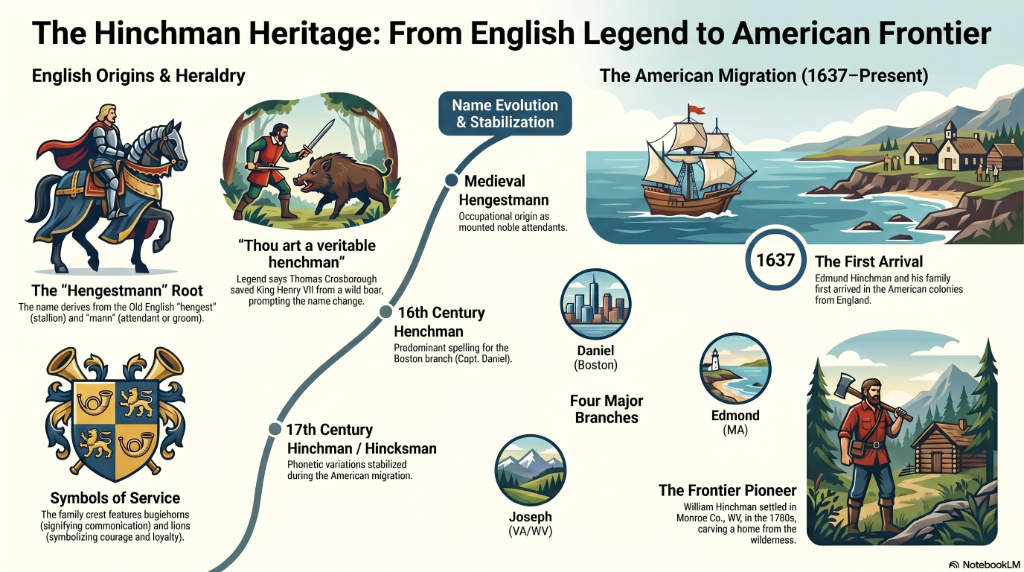
The Hinchman Heritage infographic — tracing name origins, heraldry, and the family's journey to America
Hinchman Settlement Map
Historical settlements across colonial and frontier America — click any marker to explore migration dates, family branches, and what life was like in each region.
Click any marker to explore the history of Hinchman family settlements — migration dates, key figures, and what daily life was like in each region.
The Hinchman Historical Compendium
Prepared for Hinchman.org · 17 Chapters · Extended Edition
This extended historical publication examines the origins, heraldry, migration, historical context, and evolving lineage traditions associated with the Hinchman surname and its related medieval English variants. It traces the name from its Old English roots as a title for mounted household servants, through its evolution across centuries of English history, transatlantic migration, Quaker communities, colonial settlement, and American frontier expansion.
Evolution of the Name
The name derives from the Old English hengestmann — a mounted attendant or horse servant. Over centuries, phonetic spelling by clerks who recorded names by sound transformed it through a series of variants before settling into the modern form.
Horse servant / mounted attendant
Common English form
Phonetic variant
Regional spelling
Transitional form
American / modern form
Key Historical Facts
Old English Root
"hengestmann" — horse servant
Origin Region
Northamptonshire, England
Notable Figure
Bishop Humphrey Henchman (1592–1675)
Colonial Arrival
Massachusetts, c. 1637
Colonial Settlements
NY, NJ, PA, MA, Long Island
Heraldic Symbol
Buglehorns, black chevron, lions
Religious Affiliation
Quaker communities (several branches)
Frontier Expansion
Ohio, Indiana, Illinois, Kentucky
Chapter Summaries
Click any chapter to expand its summary.
Read the Full Compendium
The complete Hinchman Historical Compendium is available as a PDF. It includes full chapter text, a selected bibliography, and historical references compiled for educational and genealogical purposes.
Prepared for historical and educational purposes. This publication does not claim hereditary entitlement to any specific coat of arms unless established through documented lineage.